


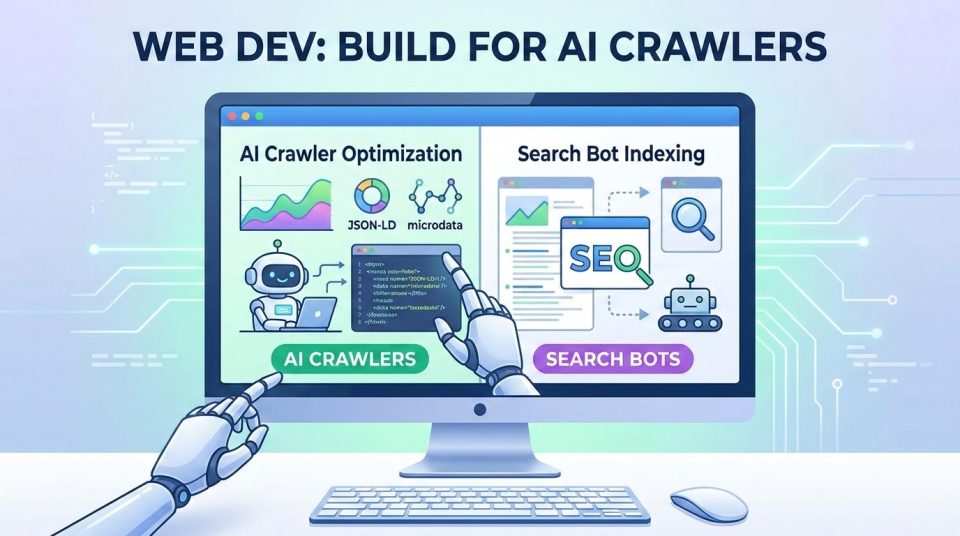
AI crawlers are replacing traditional search bots as the primary arbiters of content visibility. Web development companies that keep optimizing exclusively for ranking algorithms are falling behind. The shift demands structured data, API-first architecture, real-time accessibility, and granular access controls. Organizations that adapt now will hold a measurable advantage as AI systems increasingly decide what information gets surfaced and how.
Understanding AI Crawlers vs. Traditional Search Bots
The differences between traditional search bots and modern AI crawlers are fundamental, not cosmetic. Google’s AI crawlers process more JavaScript than standard Googlebot. OpenAI’s GPTBot identifies itself via explicit user-agent strings. Each crawler type serves a distinct purpose, and that purpose changes how web development companies should structure content delivery.
Traditional search bots index pages for user queries. AI crawlers collect training data and generate responses in real time. That distinction reshapes how development teams write crawler directives, configure server responses, and structure content accessibility.
Sites that adapt their infrastructure for AI crawlers gain ground in generative search results and knowledge panels. Sites that don’t remain invisible to the systems that are increasingly doing the finding.


Here’s a quick reference for the major crawlers currently operating:
| Crawler | User-Agent | Purpose | Identification Method |
| Googlebot | Googlebot | Traditional indexing | IP verification and DNS lookup |
| Google-Extended | Google-Extended | AI training data collection | Explicit user-agent declaration |
| GPTBot | GPTBot | OpenAI training | Direct user-agent string match |
| Claude Crawler | anthropic-ai | Anthropic model training | User-agent and reverse DNS |
| PerplexityBot | PerplexityBot | Real-time answer generation | User-agent identification |
Log file analysis reveals distinct behavioral patterns. Apache and Nginx access logs show AI crawlers requesting JavaScript resources more frequently than standard indexing bots. The timing is more varied too. Traditional bots follow predictable crawl schedules with consistent user-agent strings. AI crawlers exhibit irregular timing and often request additional assets, such as structured data files.
Regular review of crawl stats helps identify when new AI agents begin accessing content. Development teams can then adjust robots.txt rules and server configurations accordingly.
Structured Data and Schema Implementation
Schema markup transforms unstructured content into machine-readable formats that both search bots and AI crawlers can process. Schema.org vocabulary covers 800+ entity types. JSON-LD is Google’s recommended format and offers 65% higher eligibility for rich results.
Proper schema creates consistent signals that AI systems reference when processing content. It supports semantic SEO while ensuring data surfaces correctly in knowledge panels and AI overviews.
Entity-Based Markup
Start with Organization schema. At minimum, include the name, URL, logo, and sameAs properties. The sameAs field should point to Wikidata URLs to create verification pathways that AI systems trust when confirming entity relationships.
A basic JSON-LD block for a software company looks like this:
| Property | Value |
| @context | https://schema.org |
| @type | Organization |
| name | Acme Technologies |
| url | https://acmetechnologies.com |
| logo | https://acmetechnologies.com/logo.png |
| sameAs | https://wikidata.org/wiki/Q98765 |
Logo images should be at least 112×112 pixels. The name field must match the exact brand entity. Validate all markup through Google’s Rich Results Test before deployment.
Knowledge Graph Integration
Connecting schema to Wikidata Q-IDs establishes entity home signals that AI systems use for disambiguation. The process is straightforward: find the correct Q-ID via the Wikidata Query Service, add it to the sameAs property in the Organization schema, and then implement the about and subjectOf properties to link to Wikipedia pages for expanded context.
Submit the entity URL through Google Search Console Entity Management to accelerate recognition. TechCrunch achieved knowledge panel visibility within 14 days using this approach. Knowledge graph integration also strengthens E-E-A-T signals and provides AI crawlers with verifiable entity references.
Content Architecture for AI Comprehension
HubSpot’s pillar page strategy increased AI crawler visits by 340% by structuring 10 cluster articles around 3,500-word pillar content with explicit internal linking. The architecture matters as much as the content itself.
AI crawlers process page structure differently than traditional bots. Semantic HTML5 elements create logical boundaries machines can parse. The article and section tags establish clear topic boundaries. The nav tag signals important pathways through related content.
Heading hierarchies from H1 through H6 help AI systems map topic relationships across an entire site. Each pillar page should link to at least 8 cluster articles, with descriptive anchor text that explains the relationship between topics. Generic phrases like “click here” give AI crawlers nothing to work with.
Breadcrumbs, FAQ Schema, and Content Depth
Breadcrumb schema provides context about a page’s position within the site structure. Position integers in schema markup indicate the exact level of each page in the hierarchy to AI systems. This prevents AI crawlers from guessing content relationships from URL patterns alone.
FAQ schema targets conversational queries. Five to seven question-answer pairs per page give AI crawlers direct access to common questions, with complete answers that don’t require users to visit additional pages.
Content depth matters for topical authority. Shallow content creates gaps that prevent proper entity recognition. Pillar pages need substantial coverage to signal expertise that AI crawlers recognize as authoritative.
The overall structure follows a hub-and-spoke model: pillar pages at the center, cluster content radiating outward through internal links. Mapping these relationships during planning prevents orphaned pages that AI systems can’t discover through natural navigation.
API-First Design Patterns for Web Development Companies
Contentful’s GraphQL API delivers structured content 47% faster than REST endpoints for AI agents requiring selective field retrieval. Web development companies building for AI crawlers need systems that serve precise data without unnecessary overhead.
REST endpoints that follow the JSON: API specification provide consistent formatting that AI systems parse reliably. A request like /api/v1/articles?include=author&fields[article]=title, content lets crawlers fetch only what they need. This reduces bandwidth while giving AI agents clean, predictable responses.
Rate-limiting headers, such as X-RateLimit-Limit: 1000, communicate boundaries to automated systems. Content negotiation through Accept: application/ld+json headers lets crawlers specify preferred formats. These signals remove guesswork from the crawl process.
GraphQL schemas offer typed queries that define exactly what data structures exist. A schema declaring the type Article with fields for title, content, and entity relationships gives AI crawlers a map to follow rather than forcing them to reverse-engineer HTML responses.
Webhook subscriptions complete the pattern by pushing real-time changes to registered endpoints. Systems send POST requests with HMAC signature verification. This keeps AI knowledge bases current without constant polling that burns crawl budget.
Real-Time Data Accessibility
Airbnb’s XML sitemap updates lastmod timestamps every 15 minutes, enabling AI crawlers to detect content changes within 900 seconds compared to the typical 24-hour delay. Development teams need instant data pipelines that serve AI agents seeking fresh information.
Four implementation methods support real-time accessibility:
- Dynamic sitemap.xml generation via cron every 15 minutes to maintain accurate lastmod dates
- HTTP cache headers with Cache-Control: max-age=900 and ETag validation for efficient change detection
- WebSub and PubSubHubbub protocols for push notifications to subscribed AI agents
- Priority values in sitemaps ranging from 0.8 to 1.0 for fresh content, 0.3 to 0.5 for archives
Nginx configuration requires specific directives for proper Last-Modified response headers. The add_header directive sets Cache-Control values. The etag on setting enables validation checks. These configurations reduce crawl delays and improve content discoverability for AI agents processing live data.
Contextual Metadata and Embeddings
OpenAI’s text-embedding-ada-002 model creates 1,536-dimensional vectors that enable semantic similarity search. A cosine score above 0.85 indicates high relevance. Generating embeddings for every article allows AI crawlers to understand topical connections across an entire content library.
Three practical metadata enrichment strategies:
- Generate embeddings for all articles using the OpenAI API (approximately $0.0001 per 1K tokens) and store them in a vector database like Pinecone
- Add RDFa markup with Dublin Core terms like dc: subject and dc: creator to article pages
- Implement JSON-LD structured data with an about property linking to established entity URIs
Python developers can generate embeddings locally using the sentence-transformers library:
from sentence_transformers import SentenceTransformer


model = SentenceTransformer('all-MiniLM-L6-v2')

embedding = model.encode('article text here')
These embeddings become searchable through similarity queries that surface related content based on meaning rather than keyword matches. When combined with metadata enrichment, they provide AI crawlers with the contextual signals needed to index and retrieve content accurately.
Performance Optimization for AI Scraping
Cloudflare’s 94% cache hit ratio reduced AI crawler TTFB from 890ms to 45ms, a 19.7x improvement in crawl efficiency. Faster response times allow more content to be processed within limited crawl budgets.
Key performance targets:
- Lighthouse performance scores of 95 or higher
- TTFB under 200 milliseconds
- LCP below 2.5 seconds
Brotli compression shrinks HTML file sizes by 15 to 25 percent, which means fewer bytes per request and faster processing. Edge caching with 24-hour TTL and stale-while-revalidate directives keeps content available near crawler locations without hammering origin servers.
HTTP/3 with QUIC protocol reduces handshake overhead by approximately 30 percent compared to older versions. Server-side rendering eliminates JavaScript execution delays for AI systems. Critical CSS inlining delivers the main content to the crawler immediately rather than waiting for external stylesheet downloads.

Security and Access Control for AI Agents
The Washington Post’s robots.txt blocks GPTBot and Google-Extended via explicit user-agent directives, preventing unauthorized use of their content for AI training. That’s a clear example of how development teams can manage AI crawler access without blocking traditional search visibility.
Four security configurations form the foundation of access management:
- Update robots.txt with specific AI crawler blocks, such as User-agent: GPTBot followed by Disallow: /
- Implement HTTP security headers including X-Robots-Tag: noai and noindex for sensitive content areas
- Configure rate limiting through Nginx using limit_req_zone with $binary_remote_addr zone=ai_crawlers:10m rate=10r/m
- Add robots meta tags with max-snippet:0 on API documentation pages to prevent snippet extraction
Cloudflare Workers enable dynamic AI agent detection through user-agent string analysis. Scripts can identify crawler patterns and serve conditional content based on detected agent type. This lets development teams maintain different access rules for different crawlers without a single blanket policy.
Testing and Validation Frameworks
Screaming Frog SEO Spider 18.0 crawls 500 URLs per second and validates schema markup against Schema.org vocabulary with 98% accuracy. Web development companies need structured validation processes to verify how content appears to AI crawlers alongside search bots.
Five validation methods worth running consistently:
- Weekly Screaming Frog crawls to check for schema errors and broken internal links
- Google Search Console URL Inspection tool for monitoring indexing status codes
- URL Inspection API for batch validation of 100 URLs via automated scripts
- Schema validation through Google’s Rich Results Test API, which returns pass/fail results with specific error locations
- Log monitoring with GoAccess for daily analysis of AI crawler patterns
A complete validation checklist covers three categories. Schema completeness checks include JSON-LD implementation, entity home references, and business schema accuracy. Meta tag accuracy reviews canonical URLs, hreflang tags, and Open Graph settings. Sitemap validity is assessed by priority values, lastmod dates, and proper URL formatting.
Future-Proofing Development Practices
Sites that implemented E-E-A-T signals saw a 23% retention in visibility during Google’s March 2024 core update. Web development teams need to move beyond traditional search bot optimization toward structured signals that support machine understanding and content verification.
E-E-A-T stands for Experience, Expertise, Authoritativeness, and Trustworthiness. These are the signals AI crawlers increasingly evaluate when assessing content credibility.
Adding author schema with credential URLs and publication history creates verifiable connections between creators and their work. Include at least three sources that confirm expertise through external validation. This helps AI systems establish authorship credibility when processing content for training or retrieval.
Implementing content revision history via JSON-LD dateModified properties provides AI crawlers with temporal context for content changes. Granular timestamps let systems track evolution and identify the most current information available. This matters because AI systems are evaluating freshness, not just existence.
Creating entity home pages with comprehensive topic coverage ensures AI systems can locate authoritative sources for specific subjects. NetReputation, which operates across several ORM-focused domains, is one example of a company that uses entity-based architecture to maintain consistent visibility across AI and traditional search. These hub pages connect related concepts and demonstrate depth in ways that AI crawlers rely on when building knowledge representations.
Establishing citation networks that link to peer-reviewed sources and government data strengthens credibility signals. Developers should map connections between original sources and derived content. AI systems trace information lineage and assess reliability based on source quality, not just page-level signals.
Documenting content provenance with the CreativeWork schema, including the isBasedOn and license properties, provides AI crawlers with usage rights information. Clear provenance tracking supports both compliance and the trust signals that AI systems evaluate.
A quarterly audit schedule helps maintain standards across all these practices:
| Checkpoint | Focus Area | Verification Method |
| 1 | Author schema completeness | Validate all credential URLs return active profiles |
| 2 | Revision timestamp accuracy | Compare JSON-LD dates against actual content changes |
| 3 | Entity page word count | Confirm minimum coverage thresholds are met |
| 4 | Citation link validity | Test all external references remain accessible |
| 5 | Statistics update status | Review automated monitoring logs for flagged items |
| 6 | Schema property coverage | Check isBasedOn and license fields exist |
| 7 | Internal entity connections | Map topic relationships across pages |
| 8 | Structured data validation | Run schema markup testing tools |